
Buyers sometime think if they wait until the interest rate drops, then they can afford the home. That can be true IF the drop in rate doesn’t increase buyer demand and artificially increase home prices. Typically, when buyers are waiting for the rate to drop the market slows and housing inventory increases. Makes sense – there’s less buyer demand. Therefore, selling prices are lower and homes are sitting on the market longer. Now, when the interest rate drops, all those buyers that have been waiting come out and start buying. What has happened now is the housing inventory is being snatched up at a rapid pace and buyers become frantic for finding a home. We saw this happen in 2020-2021. You couldn’t get a house, and if you did, you were in a multiple offer situation and paying way over asking price. But here’s the thing – does it make sense to buy when the interest rate is cheaper but house prices may be higher because of demand. Or, is it better to buy at a higher interest rate and the homes are at a lower price point. Let’s do the math for both scenarios and see …
Here are the calculations for both scenarios:
Scenario 1: (slow market, lower pricing because of higher interest rate) $400,000 home → $20,000 down → $380,000 loan at 6.9%
Scenario 2: (low interest rate so higher demand which raised prices) $440,000 home → $22,000 down → $418,000 loan at 6.0%
Using the standard mortgage formula: M = P × [r(1+r)ⁿ] / [(1+r)ⁿ – 1] The results are surprisingly close — here’s the key takeaway:
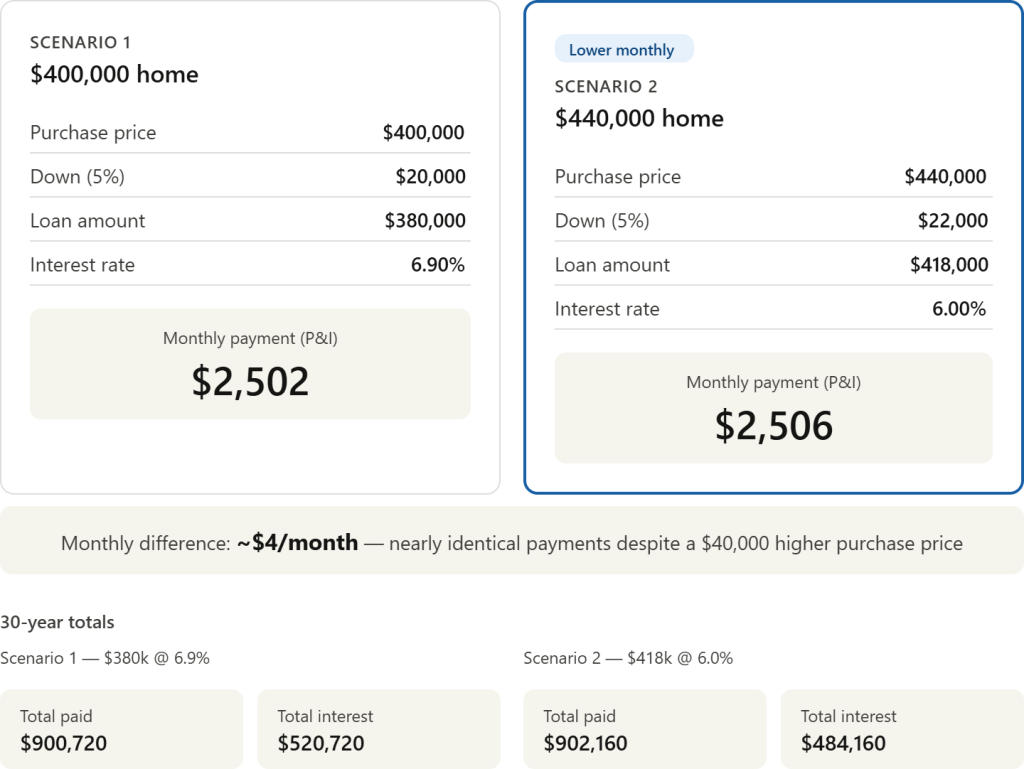
Despite being a $40,000 more expensive home, Scenario 2 costs only ~$4 more per month. The lower interest rate (6% vs 6.9%) almost entirely offsets the larger loan amount.
Where the difference really shows up is in lifetime interest paid:
- Scenario 1 pays about $520,700 in interest over 30 years
- Scenario 2 pays about $484,200 in interest — roughly $36,500 less, even with a bigger loan
So if you’re choosing between the two purely on financials, Scenario 2 (the pricier home at the lower rate) is the better long-term deal, assuming the lower rate is actually achievable. The 0.9% rate difference makes a massive difference over 30 years. But you need to stay in the home for the entire 30 years. Most home owners stay in their homes 5-7 years and move again. So in reality, if you aren’t planning to live in your home your entire life, the monthly payment (P&I only) in either scenario is nearly the same.
**Keep in mind these are principal & interest only — taxes, insurance, and PMI (which would apply to both since you’re putting less than 20% down) would add to each payment.